Selecting the right flooring for a basement requires an entirely different thought process than choosing flooring for a second-story bedroom. For homeowners in Berlin, Voorhees, and Marlton, the basement slab rests directly on the earth, meaning it is constantly exposed to temperature fluctuations and ground moisture. Installing the wrong material will quickly lead to buckling planks, trapped mold, and wasted money. Understanding how different flooring materials perform below grade ensures your new living space remains beautiful and structurally sound for decades.
The Danger of Organic Flooring Materials
The cardinal rule of basement flooring is avoiding organic materials that absorb moisture. Solid hardwood flooring—such as traditional oak or hickory planks—should never be installed below grade.
Why Solid Wood Fails
Solid hardwood is highly sensitive to humidity. In a basement environment, microscopic moisture vapor continuously rises through the concrete slab. The solid wood absorbs this vapor, causing the planks to swell, cup, and severely warp. Even with heavy vapor barriers installed, the risk of a minor plumbing leak or appliance failure destroying a massive investment in solid hardwood is simply too high.
The Carpet Debate
Wall-to-wall carpeting remains popular for basement playrooms and home theaters because it provides warmth and acoustic damping. However, carpet is highly vulnerable to moisture. If a sump pump fails or a hot water heater leaks, the thick carpet padding acts as a giant sponge. According to the Federal Emergency Management Agency (FEMA), porous materials like carpeting that are saturated with floodwater for more than 48 hours cannot be adequately sanitized and must be completely discarded to prevent severe indoor air quality hazards.
If you choose carpet for a basement, it must be installed over a rigid, dimpled subfloor system that provides an air gap between the concrete and the carpet pad, preventing trapped condensation.
Superior Waterproof Flooring Options
Modern manufacturing has produced several flooring categories explicitly designed to thrive in high-moisture, below-grade environments.
Luxury Vinyl Plank (LVP)
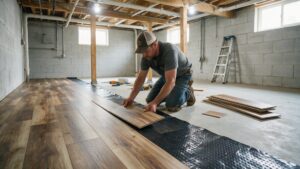
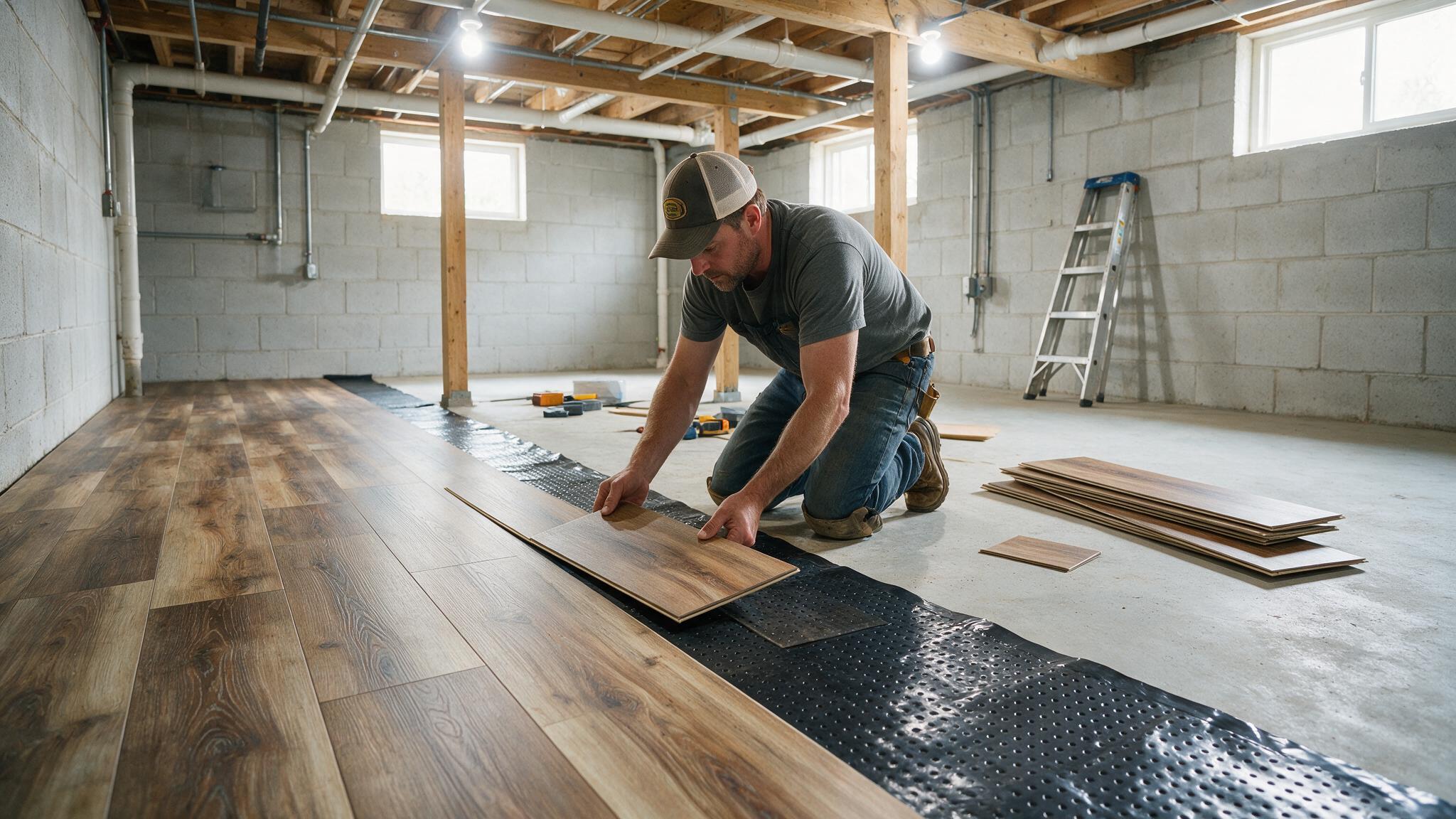
Luxury Vinyl Plank (LVP) has revolutionized basement remodeling. High-quality LVP is 100% waterproof. The planks are manufactured entirely from synthetic composite materials and feature a high-resolution photographic layer that flawlessly mimics the grain, texture, and color of real hardwood.
Because LVP is completely impervious to water, a minor basement flood will not destroy the floor; the planks can simply be dried off. Additionally, many premium LVP products feature attached cork or foam backing layers, which provide a thermal break against the cold concrete and make the floor much softer underfoot than traditional tile.
Ceramic and Porcelain Tile
If ultimate durability is your goal, ceramic and porcelain tiles are unparalleled. Tile is completely unaffected by water, making it the perfect choice for basement bathrooms, laundry areas, and home bars. However, tile is inherently cold and unforgivingly hard. To make a tile floor comfortable in a basement living room, contractors often install electric radiant floor heating mats beneath the tile during installation, transforming a cold surface into a warm, luxurious feature.
Making the Right Choice for Your Space
Your flooring choice dictates the maintenance, comfort, and longevity of your lower level. While LVP offers the best balance of wood-look aesthetics and waterproof performance, the right choice depends on how you plan to use the room. To explore material samples and discuss premium basement remodeling in Voorhees, contact Subterra Basement Remodelers. Our team will guide you toward the perfect flooring solution for your Berlin home.
FAQs:
- What is a floating subfloor and do I need one? A floating subfloor (like Dricore) consists of interlocking panels with a raised plastic dimpled base. It sits on top of the concrete, creating a crucial air gap that allows moisture vapor to evaporate while keeping the finished floor above it warm and dry.
- Is engineered hardwood safe for a basement? Engineered hardwood (a thin layer of real wood glued to a plywood core) is more stable than solid wood and can be installed below grade, but it is still vulnerable to severe water damage if the basement floods. LVP is much safer.
- Can you install epoxy flooring in a residential basement? Yes. Epoxy is an extremely durable, waterproof, poured-resin floor. While popular for garages, modern metallic and flake epoxies are increasingly used in modern, industrial-style residential basements.